At this year’s Arvamusfestival, the Estonian Dialogue Academy and the Nordic Council of Ministers’ Office in Estonia hosted the final Youth Dialogue Lab event at the Nordic Dialogue Tent. The focus was on a simple-sounding question: should young people’s access to artificial intelligence be limited?
The conversation did not stay with a yes–no answer for long. In youth-led small groups, the discussion moved to more uncomfortable questions: is it even possible to ban AI in a meaningful way, and who actually controls the technology that is already part of everyday life? Some participants said that AI can be a useful assistant, for example when exercising math. “But often we understand AI better than our teachers. How can they then teach us?”
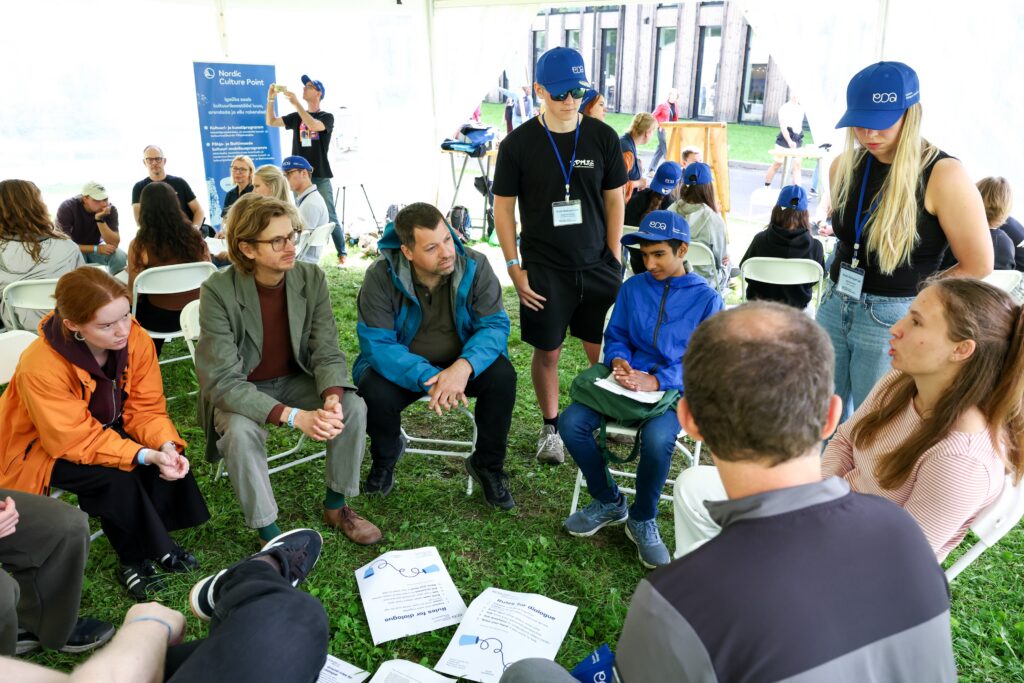
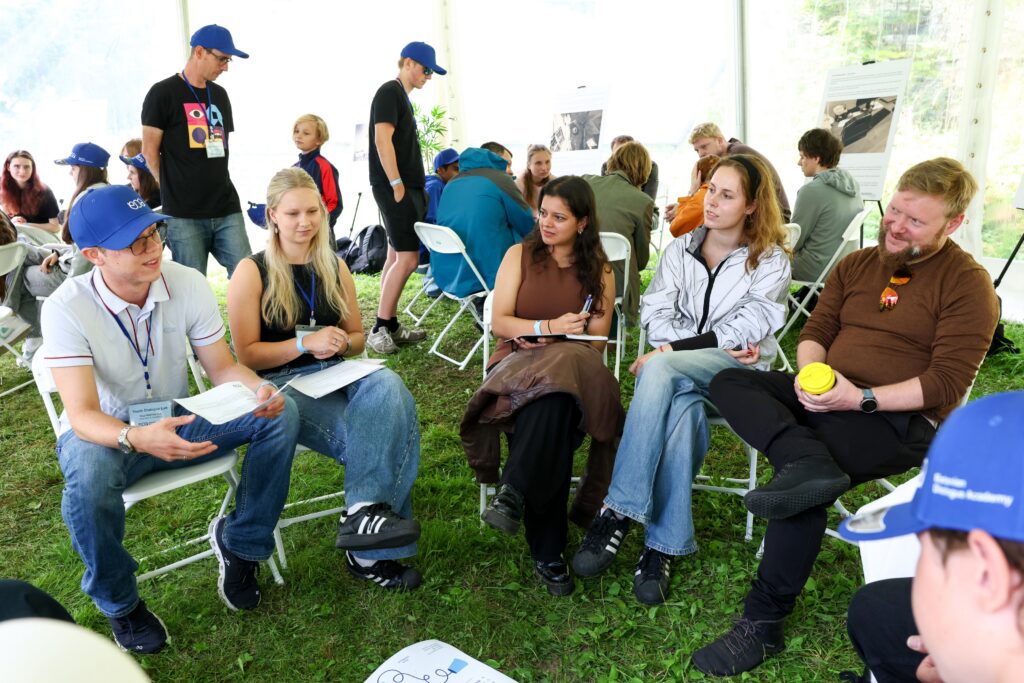
This public dialogue brought around 30 people to the tent – school students, teachers, specialists working with AI and other interested visitors. After a short warm-up, participants split into smaller circles, each led by young facilitators from the Youth Dialogue Lab together with guest experts they had invited themselves.
In one group, participants quickly arrived at the question of whether AI can really be banned. Even if a school or a country decides to prohibit certain tools, the technology stays in phones, on websites and in other countries. The discussion turned to the idea that a ban would mostly mean falling behind and losing a tool that others are learning to use.
Another issue was ownership. Part of the group argued that AI should not be controlled only by a handful of large technology companies and that its functioning should be open enough for people to understand and question it. At the same time, participants pointed out that in reality someone has to build, maintain and take responsibility for these systems. Without an owner and a person or organisation who is accountable, they would not exist at all. The tension between openness and ownership did not disappear, it simply became visible.
One of the youngest participants, a 13-year-old, brought in a different angle: the environmental cost of AI. The data centres behind chatbots and other systems use large amounts of electricity, and their cooling systems can require significant volumes of water. With that, the conversation shifted from school rules to the resources that make AI possible in the first place.
Festival visitor Christof Nichterlein observed one of the circles and told the organisers: “I was quite impressed with your discussion round and how well prepared all the students were.”
Guest experts included Ivo Visak, CEO of AI Leap (TI Hüpe); Ahmed Aleryani, AI expert at WISE; Lauri Haav, CEO of //kood; Namal Imran, teacher at Tallinn English College; and Hanna Yaremenko, teacher-methodologist and educational technologist. The Youth Dialogue Lab circles were facilitated by young people together with the Estonian Dialogue Academy team.
Youth Dialogue Lab is a programme of the Estonian Dialogue Academy where young people learn critical thinking skills, to take part meaningfully in public conversations on issues that matter to them, and to facilitate group dialogues themselves.






Photos by Kristi Sits Photography & Nordic Council of Ministers’ Office In Estonia