
Addressing Social Fragmentation and Democratic Participation in Tallinn
Autor: Olena Kozmenko, doctor in pedagogical sciences and co-founder Youth Dialogue Lab – An Estonian version of this article has been published by Erasmus+ ja Euroopa Solidaarsuskorpuse agentuur on their website.
The Youth Dialogue Lab in Tallinn was established to tackle an urgent societal challenge: the lack of meaningful opportunities for young people – especially those from diverse cultural and linguistic background – to express their views, engage in dialogue, and influence the decisions that affect their lives.
In Tallinn, young people aged 14–19 from Estonian, Russian-Estonian, and Ukrainian backgrounds often experience limited agency in civic life. This lack of inclusion is particularly acute for Ukrainian refugee youth, who face additional obstacles related to trauma, displacement, language barriers, and social integration.
Challenges
These challenges manifest in several ways. Researches conducted by Tallinn University (Toros, Kozmenko & Falch Eriksen, 2024) highlighted that Ukrainian refugee children in Estonia experience psychological distress, language barriers, school adjustment difficulties, and social isolation. Many report a lack of safe spaces where they can openly discuss issues that matter to them.
Simultaneously, local Estonian and Russian-Estonian youth also experience disengagement. They frequently lack structured opportunities to develop dialogue, facilitation, and critical thinking skills, or to participate meaningfully in civic life beyond formal education. Consequently, young people from different backgrounds tend to lead parallel social lives, with limited interaction, mutual understanding, or collective problem-solving.
Initiatives aimed solely at Ukrainian youth risk reinforcing separation rather than promoting integration. Feedback from project reviewers clearly indicates that genuine socialization and democratic learning require shared spaces where diverse young people can meet, collaborate, and learn from one another as equals.
Need
Addressing this issue is essential for both individual well-being and societal resilience. Democratic education and participation are particularly crucial for young people who have faced displacement and uncertainty. Scholars argue that democratic education supports integration, protects human rights, strengthens self-expression, and fosters tolerance and openness toward diversity.
Without intervention, the absence of youth voices in public dialogue could lead to long-term disengagement, reduced trust in democratic institutions, and weakened social bonds. Conversely, empowering young people to think critically, speak openly, and listen respectfully fosters a generation capable of addressing complex societal challenges collaboratively.
Approach
To achieve the main goals of the project, young people work together for one year in the Tallinn Youth Dialogue Lab, where they develop dialogue, critical thinking, facilitation, and organisational skills, and learn how to apply them in practice.
The Youth Dialogue Lab offers a practical, bottom-up response to these challenges. It brings together a diverse group of approximately 30 young people living in Tallinn to collaborate over the course of one year. A core group of around 10 students meet every two weeks. During four bigger events we scale up by inviting school mates and friends. The Lab equips participants with dialogue, critical thinking, facilitation, and organisational skills, enabling them to influence decision-making through conversation rather than confrontation.
Central to the project is a dialogue approach built on five key principles:
- Safe Space: Dialogue creates a safe and equal environment for open conversation.
- Focus on Realities: It addresses fundamental questions and dilemmas rooted in participants’ lived experiences.
- Democratic Topic Selection: Topics are chosen democratically by the participants.
- Collective Inquiry: Dialogue is structured as a collective inquiry rather than a debate.
- Mutual Support: Participants support one another in expressing themselves freely.
The project began with a visit to the Arvamusfestival (Opinion Festival) in Paide, Estonia, in August 2025. There, participants took part in discussions on libraries, youth, equality in education, democracy, and Baltic cooperation. The question they specifically discussed was: “Should students have a voice in the recruitment process for new school teachers?”
Practical work
In September, the project officially launched with a kick-off meeting in Telliskivi Loomelinnak, bringing together the core group of Youth Dialogue Lab.
During the first months of the project, the group held ten engaging meetings. In October, participants visited the Ballot Paper exhibition at Tallinna Pelgulinna Riigigümnaasium (PERG), which showcased ballot papers from different countries and historical periods. The exhibition inspired a dialogue on student voices and democracy.
In November, the group visited Vabamu Museum, gaining a deeper understanding of Estonia’s recent history and the development of its modern free society. Following the visit, participants worked with concepts such as freedom of the press, freedom of movement, and freedom of speech. This exercise encouraged participants to reflect on which freedoms they personally value most and why, while also exploring the many layers of the concept of freedom.
The group also visited the NGO Mondo in Tallinn. An interactive presentation by Global Education expert Mari Jõgiste introduced Mondo’s international aid work and global education programme. This was followed by a thought-provoking dialogue titled “Why should we care about people we don’t know?” Participants examined the question from multiple perspectives. They discussed the differences between helping people close to them and supporting unfamiliar people through organisations like Mondo, and reflected on their own motivations for helping others.
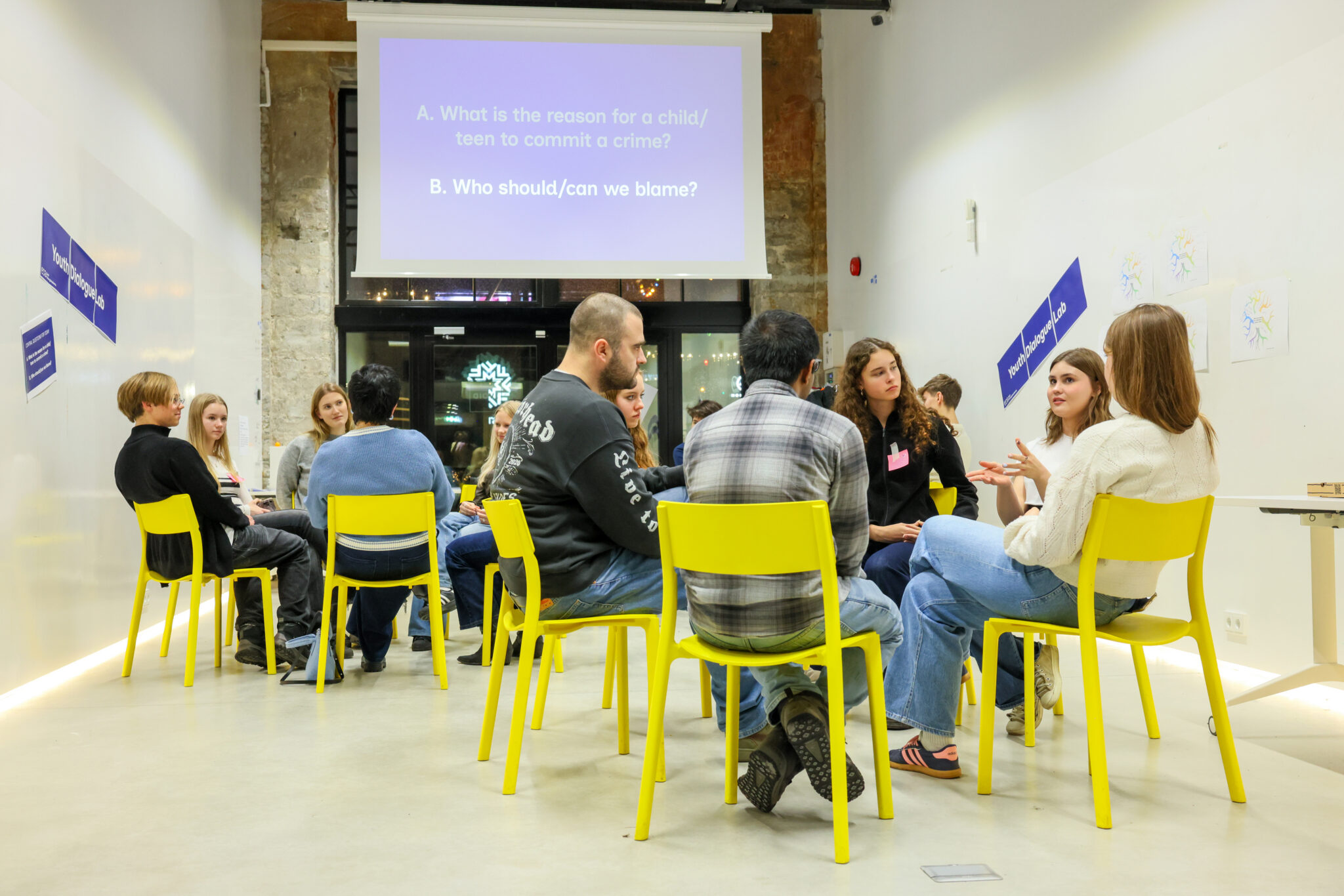
As part of the programme, two round-table dialogues with guests from various fields are organised. The first round-table took place on 9 December 2025 and attracted 30 participants to discuss the topic “What are the reasons a child or teenager might commit a crime?” In preparation, members of the Youth Dialogue Lab invited experts to support the group discussions, including two Estonian police officers working with young offenders and child protection expert Jane Snaith from the NGO Igale lapsele pere (“A Family for Every Child”)
During our next meetings, we plan to visit other interesting places, participate in events dedicated to Estonian Independence Day and Europe Day, organize a discussion at a large corporation, and gain experience communicating with politicians in the Estonian Parliament.
Expected outcomes
At the end of the project, participants will work towards organising a public dialogue at the Arvamusfestival 2026. This event will be fully led by the young people themselves, with support from the Nordic Council of Ministers’ Office in Estonia.
The expected outcomes include improved integration, stronger self-determination and self-expression, increased confidence, and a greater sense of belonging. Participants gain civic experience that will benefit them throughout their lives -in communities, workplaces, and democratic institutions.
By engaging youth from Estonian, Russian-Estonian, and Ukrainian backgrounds together, the Youth Dialogue Lab actively promotes European common values such as equality, openness, and inclusiveness – not through abstract instruction, but through lived experience. Participants learn by encountering differences, recognising similarities, and co-creating meaning through dialogue.
You can read more about Youth Dialogue Lab here.
Reference
Toros, K., Kozmenko, O., & Falch Eriksen, A. (2024). ‘I just want to go home, is what I need’: Voices of Ukrainian refugee children living in Estonia after fleeing the war. Children and Youth Services Review, 158, 107461. https://doi.org/10.1016/j. childyouth.2024.107461